Every week, I filter through everything Microsoft ships on Azure Logic Apps, AI Agents, API Management, Copilot Studio, and the broader Integration Platform — and surface only what working professionals actually need to know and act on. No press releases. No marketing fluff. Just the signal.
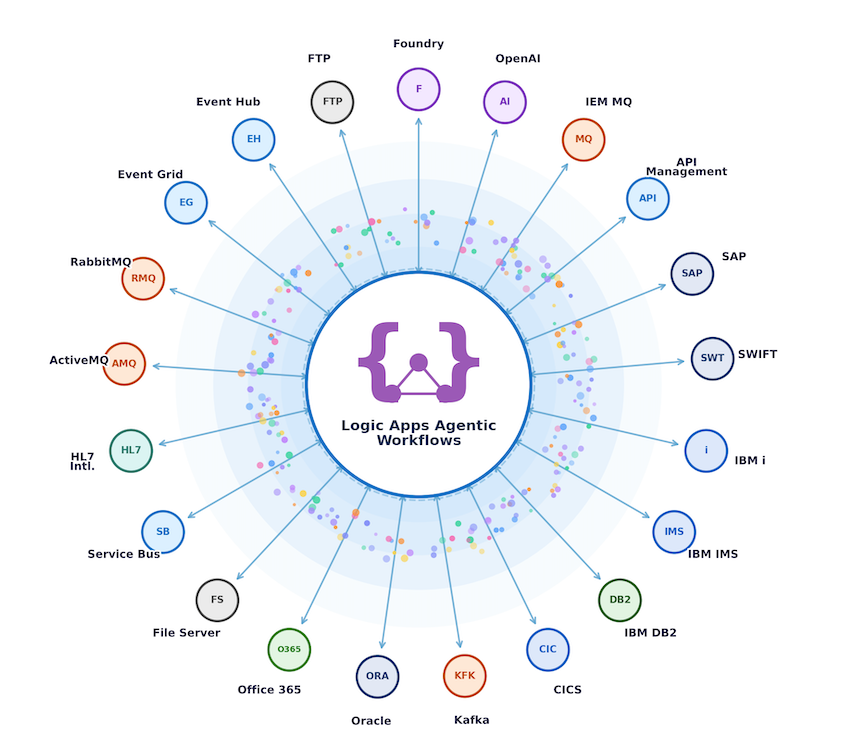
This week’s Signal – Gautam’s Take
Every surface in Microsoft’s integration stack now speaks MCP — and they all shipped in the same three-week window.
In the last three weeks, Microsoft shipped MCP tooling across Logic Apps Standard, Azure API Management, Azure Functions, and Power Platform — simultaneously. The Logic Apps in-portal MCP wizard is now in preview, letting you configure authentication, server creation, and tool exposure directly from the Azure portal without touching JSON. APIM shipped updated service limits for MCP-exposed APIs with a tiered rollout schedule. Azure Functions GA’d MCP extension support across .NET, Java, JavaScript, Python, and TypeScript. And the 2026 Release Wave 1 plan — which goes live April 1 — includes Power Platform MCP server building from connectors as a headline feature.
What this means for integration practitioners is that MCP is now the agentic integration contract — the same role that WSDL played for SOAP, or OpenAPI for REST, but purpose-built for AI agent consumption. Your Logic Apps workflows become tools. Your Service Bus topics become tool inputs. Your APIM gateway becomes the auth broker. If you have been building integration services on Azure for the last ten years, you already have the primitives — they just need MCP endpoints wired up. The muscle memory from BizTalk translates directly: receive location → MCP tool definition, orchestration → Logic Apps workflow, send port → outbound tool call.
The forward signal is the 2026 Release Wave 1 plan published March 18. It confirms: Power Automate getting agentic triggers (agents can invoke and adjust automated processes), Copilot Studio A2A protocol going GA this wave, and Power Platform MCP server building from connectors becoming generally available. That last point matters most: your existing Logic Apps connectors — all 1,400+ of them — become MCP-discoverable tools with governance via DLP policies. The integration platform is the AI platform. That is not marketing — that is architecture.
AI + Integration
Azure API Management Your Auth Gateway For MCP Servers
The pattern solidifying this week is APIM as the production MCP gateway — not just for REST APIs, but as the centralized auth broker sitting between AI agents and MCP servers. The architecture: APIM gets the public IP, the MCP server (Logic Apps Standard or Azure Functions) lives inside a private VNet accessible only through APIM’s internal routing. APIM fills the gaps in the current MCP spec: no standard scope taxonomy for tools, no standard token introspection for multi-server scenarios. Those become APIM policy concerns — JWT validation, rate limiting, managed identity — using capabilities your team already knows how to operate.
- OAuth and API key auth both supported in the Logic Apps in-portal MCP wizard
- APIM policy layer handles rate limiting, logging, and auth enforcement across all MCP tool calls
- Power Platform DLP policies govern which MCP servers connectors can expose — governance by default
Connect an agent available over the Agent2Agent (A2A) protocol
Copilot Studio’s Agent-to-Agent (A2A) protocol is going GA in 2026 Wave 1. The protocol defines a standard contract for agent communication: an orchestrator agent sends tasks to external agents and receives responses in a predictable format. Combined with MCP tool calling, the complete architecture is: A2A for agent-to-agent delegation, MCP for agent-to-service tool calling. These are complementary. Your Logic Apps workflow serves as an MCP tool that an A2A-orchestrated Copilot Studio agent can invoke as part of a multi-agent process. For BizTalk architects: this is orchestration — just distributed and AI-driven. The orchestration engine is the agent network; the receive ports and send ports are the MCP tool definitions.
Microsoft Announcements and Updates
- Copilot Cowork: A new way of getting work donemicrosoft.com
- AI for nuclear energy: Powering an intelligent, resilient futuremicrosoft.com
- Navigating digital sovereignty at the frontier of transformationmicrosoft.com
- What’s new with Microsoft in open-source and Kubernetes at KubeCon + CloudNativeCon Europe 2026opensource.microsoft.com
Community Blog Posts
- What we wish we knew about building AI agentsby Ian newsletter.posthog.com
- Harness design for long-running application developmentby Prithvi anthropic.com
- Full-stack vibe coding made easyby Richard seroter.com
- State of Context Engineering in 2026by Aurimas newsletter.swirlai.com
- How can engineering leaders assess their AI maturity?by Lizzie rdel.substack.com
- Azure FinOps: The Complete Guideby Damian turbo360.com
- Getting Started: Copilot Studio with VS Code and AIby Mikko mikkokoskinen.com
- Connecting to Dataverse: Modern .NET Authentication with ServiceClientby Kailash mytrial365.com
- The New Era of Integr-AI-tion: What Actually Changes, and What Doesn’tby Pim codit.eu
- The Hidden Retry Behavior That Makes Logic Apps Feel Stuckby Sandro blog.sandro-pereira.com
Podcasts
- Prevent agentic identity theftby The Stack Overflow Podcast stackoverflow.blog
- Coding for Security with Chris Ayersby dotnetrocks dotnetrocks.com
Video
- The Transformation of the Developer Role with AI Agentsby Microsoft youtube.com
- Foundry IQ: Building the Data Pipeline with Knowledge Sourcesby Microsoft youtube.com
Microsoft Learn Paths
- Set Up Standard Workflows as MCP Servers — Azure Logic AppsThe official Microsoft Learn documentation for configuring Logic Apps Standard as an MCP server learn.microsoft.com
- AI Gateway Capabilities in Azure API ManagementComprehensive reference for all GenAI Gateway capabilities now available in Azure API Management — token quotas, semantic caching, circuit breakers, backend load balancing, and content safety integration. learn.microsoft.com
- Migration approaches for BizTalk Server to Azure Logic AppsMigration approaches for BizTalk Server to Azure Logic Apps — Microsoft Learn reference covering assessment, pattern mapping, and toolchain selection including the new ODXtoWFMigrator. learn.microsoft.com
That’s it for this week. If you found this useful, consider forwarding it to a colleague who works with Microsoft Integration Stack.
Have a tip, use case, or tool worth sharing? Reply to this email — I read every one.
Until next week,
Gautam